Category: power lift chairs
Posted by 2026-01-06 10:01
hoyer lift operation video
Hoyer Lift Operation Videos: Visible Safety, Learnable Caregiving
In the high-risk process of patient transfer, written instructions and verbal guidance often fail to fully convey the details and rhythm of operations. However, a clear, standardized Hoyer Lift operation video centered on patient safety can intuitively demonstrate every key action—from the "click" sound of extending the base legs, to the rolling technique for positioning the sling, and the slow rotation of the release valve during lowering. For this reason, high-quality operation videos have become an indispensable tool in modern caregiving training.
Whether you are a new nurse, a family caregiver, or a manager of an elderly care facility, watching and learning from authoritative Hoyer Lift operation videos not only helps you quickly master technical essentials but also builds a deep understanding of the "safe transfer" culture. This article explores the value of Hoyer Lift operation videos, core content elements, recommended resources, and usage suggestions to help you move from "understanding" to "doing it correctly."
Why Are Operation Videos More Effective Than Text?
Operating a Hoyer Lift involves multi-dimensional skills such as spatial judgment, force control, and timing. Relying solely on reading step-by-step checklists can easily lead to missed details. For example:
"The base legs must be locked"—text cannot show the dangerous tilt angle of the equipment when legs are unlocked;
"Position the sling at the mid-thigh"—images struggle to illustrate the nerve damage risk if the sling presses against the popliteal fossa (back of the knee);
"Slowly rotate the release valve"—only videos can demonstrate the critical difference between forceful twisting and steady rotation, which can mean the difference between safety and harm.
Through real-scenario reproduction, slow-motion breakdowns, multi-angle shooting, and voice narration, videos transform abstract standards into imitable behavioral models. Studies show that the error rate of operations learned through videos is nearly 40% lower than that of training using text alone.
What Should a High-Quality Hoyer Lift Operation Video Include?
1. The Complete 7-Step Process
It must cover everything from environmental assessment and equipment inspection, to extending the base legs, applying the sling, conducting a low-altitude test, lifting and moving, controlling lowering, and removing the sling. In particular, steps like the "low-altitude test"—which are easily overlooked but crucial—must not be skipped.
2. Dual-Perspective Presentation
First-person perspective (GoPro or head-mounted camera): Shows the caregiver’s hand movements, focus of vision, and body posture;
Third-person panoramic perspective: Displays the spatial relationship between the equipment, the patient, and furniture, helping viewers understand path planning.
3. Close-Ups of Key Details
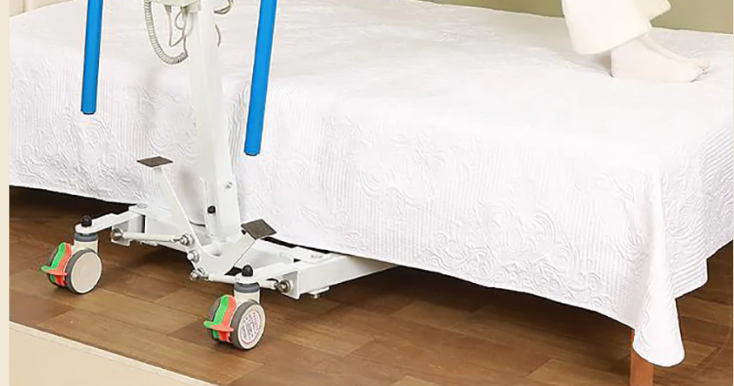
The moment the base leg locking pins pop into place;
The distance between the sling’s leg straps and the back of the knees;
The rotation speed and finger pressure applied to the manual release valve;
The way to press buttons on the remote control.
4. Side-by-Side Demonstration of Common Mistakes
High-quality videos not only show "the correct way" but also simulate typical errors (e.g., partially extended legs, twisted slings, rapid lowering). They use subtitles or narration to explain the consequences, strengthening risk awareness.
5. Integration of Humanistic Care
Genuine professional operation is not just about technique. Videos should showcase communication between the caregiver and patient: "We’re starting now—it might feel a little cool" or "Take your time, no rush." These words convey respect, not just the completion of a task.
Recommended Authoritative Operation Video Resources
1. Arjo’s Official YouTube Channel
As the owner of the Hoyer brand, Arjo provides multilingual operation videos for various models (including electric, manual, and ceiling-mounted lifts). The footage is professional and steps are rigorous, making it suitable for institutional training.
2. Medline Industries’ Operation Guide Series
Its Safe Patient Handling with Hoyer Lift video series is based on clinical scenarios, with a special focus on infection control and sling selection. It is ideal for reference in hospital settings.
3. U.S. Occupational Safety and Health Administration (OSHA)
OSHA’s official website offers free Safe Lifting Techniques educational videos. Though not exclusively about Hoyer Lifts, they deeply analyze the hazards of manual lifting and emphasize the need for mechanical assistance.
4. Nursing Education Channels on YouTube (e.g., RegisteredNurseRN, Level Up RN)
Content created by registered nurses uses plain language, often including exam key points and memory mnemonics. It is suitable for self-study by family caregivers.
Note: Always check the video release date (prioritize content from 2020 onwards), as safety standards and equipment designs have been updated in recent years.
How to Effectively Use Operation Videos for Learning?
Watch the full video first, then study segments in detail: Get an overview of the entire process initially, then repeatedly review difficult segments (e.g., "sling application," "lowering control") later.
Take notes while watching: Jot down details you tend to miss, such as "The base legs must make a clicking sound to confirm they’re locked."
Practice with simulations: In the absence of a patient, practice operations using a mannequin or pillow, and correct your posture by comparing it to the video.
Organize group viewings and discussions: Staff at nursing homes or family members can watch together to unify operation standards and avoid disputes caused by "what I think is correct."
Save videos to your phone for offline viewing: Quickly review key steps before actual operation, especially useful for emergency or nighttime care.
Risks of Low-Quality Videos
Not all online videos are reliable. Be cautious of the following types:
"Quick tutorials" without brand logos or professional endorsements;
Videos that omit safety steps (e.g., no low-altitude test, no sling inspection);
Demonstrations using damaged equipment or non-standard slings;
Videos with cluttered backgrounds, no narration, no subtitles, and only showing "results" rather than "processes."
Remember: An incorrect operation demonstration can be more dangerous than no demonstration at all.
Conclusion: Let Every Viewing Be a Starting Point for Safety
The value of Hoyer Lift operation video lies not only in teaching us "how to do it" but also in awakening our understanding of "why we do it this way." When the camera focuses on the caregiver squatting down to adjust the sling for an elderly person, what we see is not a mechanical process, but respect for life.
In an era where information is easily accessible, making good use of high-quality video resources is the responsibility of every caregiver—and the most practical protection for our loved ones.